
Contact Info
- 289-968-5968
- info@jaideproducts.com
-
32 Seapark Dr, St. Catharines,
Ontario, CANADA L2M 6S6

The Roturner by Jaide Products is a sit-to-stand transfer aid used by stroke survivors, people with Parkinson’s disease and MS, and patients recovering from hip and knee surgery. Its sling-free, wrap-around frame design supports partial weight-bearing transfers in under 60 seconds, making it suitable for home care and clinical settings across a wide range of neurological and post-surgical conditions.
When mobility is compromised by a neurological condition or major surgery, daily transfers become the most physically demanding and emotionally significant moments of the day. The right standing transfer aid can determine whether a person remains safely at home or must move to a care facility. This guide addresses the specific mobility challenges of four common conditions and explains what to look for in a transfer device for each.
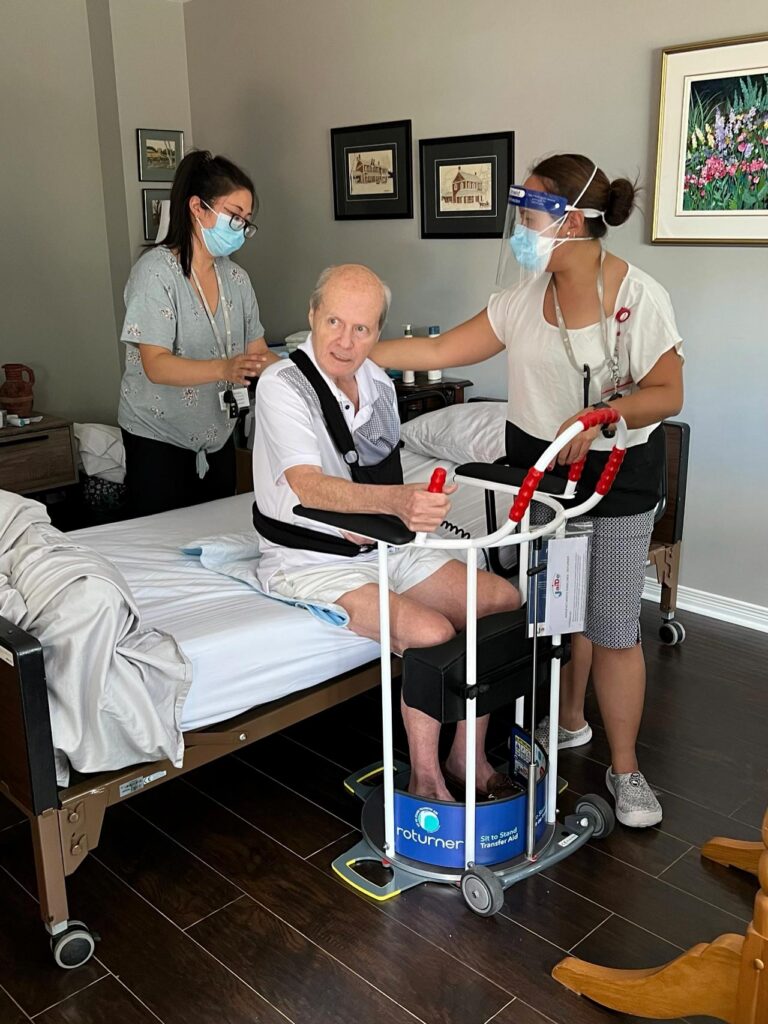
Stroke survivors commonly experience hemiplegia or hemiparesis weakness or paralysis on one side of the body. They may also have impaired balance, reduced sensation, difficulty following multi-step instructions, or spasticity. Transfer risk is highest in the early post-stroke period but remains elevated long-term if strength recovery plateaus.
The Roturner’s wrap-around open frame gives stroke patients a large, stable structure to hold throughout the transfer not just a single narrow handle. The patient leans forward (a natural, cue-responsive movement), grips with their stronger arm, and the caregiver guides the pivot. Physiotherapists note that this sit-to-stand sequence promotes weight-bearing through both legs and core which is clinically valuable for neurological recovery and reducing muscle atrophy on the affected side.
View the full transfer sequence: How It Works – Roturner
Parkinson’s disease causes tremors, rigidity, bradykinesia, and freezing of gait — one of the most functionally disabling symptoms. Many people with Parkinson’s retain good leg strength but freeze at movement initiation, particularly during the sit-to-stand transition. Falls are the leading cause of injury in Parkinson’s patients.
The Roturner functions as an excellent Parkinson’s standing aid because it provides a concrete, structured, tangible target for movement initiation. The patient sees the frame and, grabs it, a clear single-action cue. The forward-lean of the transfer aligns directly with the physiotherapy cuing strategy already used with Parkinson’s patients. Because there are no slings to fit, pre-transfer setup is fast and simple, reducing the anxiety that worsens motor freezing.
Multiple sclerosis creates variable, unpredictable mobility impairment. MS patients experience periods of fatigue-related weakness, spasticity, and balance impairment. Fatigue is the most reported MS symptom and significantly affects transfer safety: a patient who transfers independently in the morning may need substantial assistance by afternoon.
The Roturner’s sling-free design means it requires the same setup time and physical effort whether the patient is having a high-function or a fatigued day. The patient only needs to grip the frame and lean slightly, the caregiver manages the pivot. This consistency is valuable for both safety and for caregiver planning. Family members and home support workers can rely on the same process every time, regardless of where the patient’s MS is that day.
Following total hip replacement (THR), patients are given strict post-surgical precautions: no hip flexion beyond 90 degrees, no crossing of the legs, no internal rotation of the hip. These restrictions directly affect how the patient can sit, rise, and pivot during transfers. Violating them even slightly risks dislocating the prosthetic joint.
The Roturner’s upright, frame-supported transfer naturally maintains the patient’s hip at a safe angle. The Roturner is listed under Orthopaedics applications on the Jaide Products How It Works, with specific applications including ‘first time standing post-operatively’ and ‘promoting increased patient self-efficacy and confidence’ critical outcomes for surgical recovery psychology.
Depending on the stage of the disease, some Parkinson’s patients can use the Roturner with minimal caregiver input, for example, the caregiver may only need to be present for guidance rather than providing physical support. An occupational therapist can assess the appropriate level of caregiver involvement for a specific individual.
Yes. The Roturner is specifically designed for home use. It fits through standard doorways, weighs approximately 25 lbs, and requires only one caregiver. Many post-stroke home care clients use it successfully from the early recovery period onward. Beyond transfers, the Roturner is also used as a rehabilitation tool, supporting sit-to-stand exercises that build leg strength and confidence, as well as exercises like leg kickbacks that can be performed safely while the patient holds the frame for balance and support.
The Roturner has documented orthopedic applications and is used by physiotherapy teams for post-operative standing and transfers. Always confirm appropriateness with your surgical team and physiotherapist based on your specific hip precautions.
The Roturner is designed to require minimal patient effort even during a fatigue episode. In the event of a fatigue episode, the patient only needs to hover over the seat rather than stand straight up to transfer. The caregiver manages the pivot. This makes it well-suited to the variable-capacity nature of MS.
Yes. The Roturner is used across a range of conditions including but not limited to ALS, cerebral palsy in adults, traumatic brain injury, and general age-related deconditioning. Contact Jaide Products to discuss specific clinical needs.
Many clients living with neurological conditions or recovering from surgery have successfully received funding to help cover the cost of the Roturner. Below are several programs worth exploring:
Funding eligibility varies by program, province, and individual circumstances. We recommend contacting the relevant organization directly to confirm whether the Roturner qualifies under your specific situation. You can also reach out to the Jaide Products team, we’re happy to help guide you through the process.
Whether you’re supporting recovery from surgery or managing a long-term neurological condition, the right standing transfer aid can restore independence, dignity, and safety to daily life — for both the patient and their caregiver.
Shop the Roturner – Standard and Bariatric models →
Download the clinical brochure →
Request a product demo or quote →
Contact the Jaide Products team →