

Contact Info
- 289-968-5968
- info@jaideproducts.com
-
32 Seapark Dr, St. Catharines,
Ontario, CANADA L2M 6S6
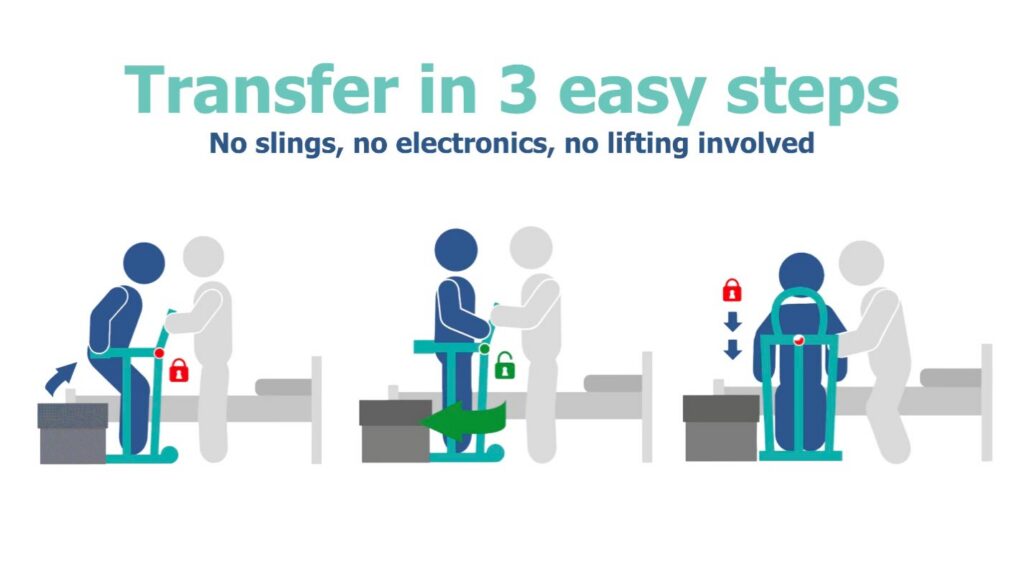
The safest way to transfer a patient without lifting them is to use a sit-to-stand transfer aid, a device that supports the patient through the stand-and-pivot sequence while the caregiver guides rather than lifts. The Roturner by Jaide Products is a Canadian-made, sling-free sit-to-stand transfer device with a 550 lb weight capacity that completes transfers in under 60 seconds.
Every day, home caregivers, PSWs, and healthcare professionals perform dozens of patient transfers helping someone move from bed to wheelchair, from a chair to a commode, or between surfaces. These transfers are among the most physically demanding tasks in caregiving and a leading cause of musculoskeletal injury. This article covers safe patient transfer techniques and the equipment that makes them sustainable long-term.
The human back was not designed to repeatedly lift another adult. Even with proper posture, manually hoisting or pivoting a person who has limited mobility creates enormous compressive force on the lumbar spine. Common injury points include:
The risk is compounded when the patient is fearful, uncooperative (not willfully just due to their condition), or heavier. A transfer aid is not a luxury; for many care situations, it’s a clinical necessity.
Whether you’re a professional caregiver or a family member helping a loved one, these principles form the foundation of injury-free transferring:
The “two-person lift” has long been the default advice but two-person transfers still cause injury, create scheduling challenges, and are rarely feasible in a home care setting. Instead, rely on a device that does the mechanical work for you.
The further a load is from your body, the greater the torque on your spine. This is why lateral transfers where the patient slides sideways rather than being lifted up and over are safer biomechanically.
Classic advice, but often ignored in the rush of a busy shift. Bend at the knees, keep your spine neutral, and drive upward through your legs. If the patient’s weight makes this impossible to do safely, you need a mechanical solution.
A patient who knows what’s coming, who can grip, weight-bear even slightly, or brace is a safer transfer. Explain each step. Encourage participation. Active participation from the client reduces the caregiver’s load significantly and promotes the client’s physical and emotional wellbeing.
The most common transfers from chair to wheelchair, wheelchair to toilet, wheelchair to bed all share one critical moment: the transition from sitting to standing. A sit-to-stand transfer aid supports the patient through that pivot, holding their weight so you don’t have to.
A sit-to-stand transfer aid (also called a standing transfer aid or patient turner) is a medical device designed to assist a partially weight-bearing patient to rise from a seated position, pivot safely, and be lowered onto another surface all with minimal physical effort from the caregiver.
Unlike a Hoyer lift (which requires the patient to be completely passive and non-weight-bearing), a sit-to-stand device actively engages the patient in the transfer. This means:
For many patients recovering from stroke, hip surgery, or living with neurological conditions like Parkinson’s disease or MS, a sit-to-stand aid is the bridge between immobility and independence.
The Roturner by Jaide Products is a heavy-duty, minimal-touch sit-to-stand transfer device designed and manufactured in Canada. It was developed to solve a real problem: existing transfer equipment was either too complex, too unsafe, too heavy, or simply not built for the realities of home care.
What makes the Roturner different:
Clients at assisted living facilities, retirement homes, and in private home care across Canada have called it “life-changing.” Many facilities have replaced multiple Hoyer lifts with Roturners reducing equipment costs while actually improving the quality and dignity of transfers.
See how the Roturner works — watch the step-by-step transfer demonstration
Even with the best patient transfer equipment, technique still matters. Here’s how to execute a safe transfer using a sit-to-stand device:
Step 1 – Prepare the equipment and environment
Position the Roturner directly in front of the patient. Ensure the destination surface (wheelchair, commode, bed) is close, locked, and at an appropriate height. Clear any obstacles.
Step 2 – Position the patient
The patient’s feet should be flat on the footrests of the device. Their knees are gently supported. Their hands reach forward to grip the frame.
Step 3 – Cue the patient to lean and rise
With your hands lightly guiding at the patient’s hips or mid-back never pulling under the arms cue them to lean forward and push through their feet to stand or pull through their arms. The device does the structural work.
Step 4 – Pivot to the destination surface
Once standing, the caregiver guides the patient in a gentle rotation no lifting required. The Roturner’s swivelling base footrests rotates with the patient.
Step 5 – Lower slowly to the new surface
Guide the patient to lower themselves, again using their own leg and core strength where possible. The caregiver controls the descent they don’t bear it.
This technique reduces the risk of caregiver musculoskeletal injury while simultaneously encouraging the patient’s active participation in their own care, a key goal of both occupational therapy and physiotherapy practice.
If you’re caring for someone at home and struggling with transfers, don’t wait for an injury to prompt action. Contact an occupational therapist, many are available through your provincial healthcare organization (Ontario Health at Home) or private clinics. They can assess the specific needs of your situation and recommend the right patient transfer equipment.
You can also contact our Jaide Products team directly, they work with OTs, physiotherapists, and care coordinators to match the right device to each client’s needs.
Safe caregiving starts with the right tools. The Roturner was built by Canadians, for Canadian caregivers designed for real homes, real bodies, and the real challenges of daily transfers.
Shop the Roturner Standard and Bariatric models →
Request a quote for your facility →
Talk to our team about the right solution for your situation →
Use a sit-to-stand transfer aid like the Roturner. Position the device in front of the patient, cue them to lean forward and use their legs or upper body to stand (even partially), then pivot and lower them onto the wheelchair. The device supports their weight throughout the transfer so you guide rather than lift.
Ensure their feet are flat on the floor, encourage them to lean forward (“nose over toes”), and let them push through their arms and legs. If they lack the strength to do this safely, a sit-to-stand transfer aid provides the external support needed without requiring the caregiver to lift.
With the right equipment, yes. The Roturner is specifically designed for one-person transfers, a key advantage for home caregivers and understaffed overnight shifts in care facilities.
A Hoyer lift is a passive lift the patient is suspended in a sling and bears no weight. It’s appropriate for fully non-weight-bearing patients. A sit-to-stand aid is for partially weight-bearing patients. It promotes active participation, which is better for the patient’s physical rehabilitation and dignity and quality of life.
Yes. The Roturner is available for purchase through a medical equipment store across Canada. View our products and shop online.