

Contact Info
- 289-968-5968
- info@jaideproducts.com
-
32 Seapark Dr, St. Catharines,
Ontario, CANADA L2M 6S6
The best sit-to-stand transfer aid for home care is one that: (1) supports the patient’s weight capacity with margin, (2) requires no slings or harnesses, (3) weighs under 30 lbs, (4) fits through standard residential doorways, and (5) can be operated by one caregiver. The Roturner by Jaide Products meets all five criteria, with a 550 lb capacity, 25 lb device weight, and sling-free design built for Canadian home care.
You have decided that manually helping a parent, spouse, or client stand from a chair is no longer sustainable. Maybe there has been a close call. Maybe your back is aching. Maybe your loved one refuses transfers because they are afraid of falling. Whatever the trigger, choosing the right sit-to-stand transfer aid is one of the most impactful decisions in home caregiving. This guide walks you through who qualifies, what features matter, and how to select the right device for your situation.
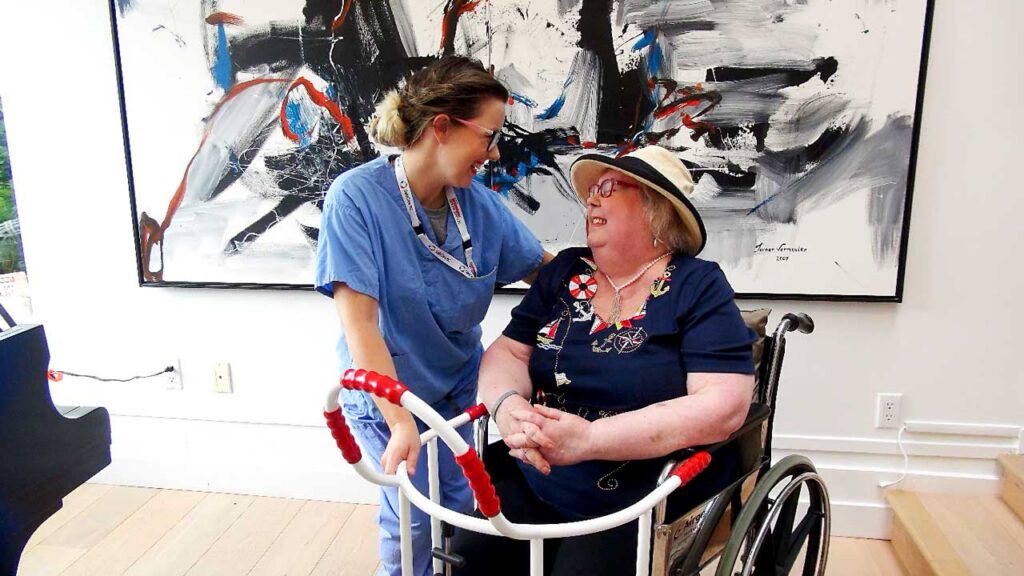
An ideal candidate for a sit-to-stand transfer aid meets these criteria:
1. Partially weight-bearing: can put weight through their feet, even minimally, when prompted
2. Can follow basic instructions: understands what is being asked, even if they cannot initiate movement easily
3. Has some grip strength: can hold a frame or handle, even with one hand
4. Not a full hoist patient: if someone is completely non-weight-bearing, a passive ceiling or floor lift is more appropriate
Eligibility includes stroke survivors, older adults with osteoarthritis or deconditioning, people with Parkinson’s disease or MS, post-surgical patients, and those with early-to-mid-stage dementia who retain physical function.
Never buy a device at the edge of its weight capacity. Dynamic loads during a transfer can momentarily exceed the patient’s static body weight. Choose a device rated at least 20–30% above the patient’s weight. The Standard Roturner handles approximately 550 lbs; the Bariatric Roturner reaches 550 lbs.
Many sit-to-stand devices require a harness to be fitted before each transfer, adding complexity and reducing dignity. The Roturner requires no slings, straps, or harnesses. The patient enters the frame, grips the handles, and transfers. This reduces setup time, reduces patient anxiety, and preserves dignity.
That said, some caregivers prefer to use the Roturner alongside a transfer belt, a belt worn around the patient’s waist with handles that give the caregiver a secure grip point if extra support is needed. A transfer belt is entirely optional and not required for safe use, but it can offer added reassurance for caregivers supporting patients with less predictable balance or strength.
A device too heavy or too bulky to move between rooms becomes a barrier. In home care, you need the device in the bedroom in the morning and the bathroom shortly after. The Roturner weighs approximately 25 lbs and features a compact footprint that fits comfortably in smaller home spaces. This includes tight bathrooms and narrow hallways where larger clinical devices simply won’t work. This makes it a more practical choice than bulkier alternatives like the Sara Stedy, which was designed for hospital corridors rather than residential floor plans.
Many clinical transfer devices were designed for hospital corridors. A device that cannot fit through a 30-inch bathroom doorway is unusable in home care. The Roturner is engineered specifically for residential floor plans.
When a transfer device keeps the patient weight-bearing and using their own muscles it contributes to maintaining muscle tone, slowing functional decline, reducing caregiver load, and preserving their sense of agency. These are not minor benefits: they are key goals of both occupational therapy and physiotherapy practice.
In home care, a second caregiver is rarely available. The Roturner is designed for one-person operation. It has replaced two-person manual transfers, converting what required multiple caregiver task. See applications on the How It Works.
Medical equipment in home care must be wipe-cleanable and durable. The Roturner is built with commercial-grade materials that can be disinfected between uses important for multi-resident care settings and infection-control households.
| Specification | Standard Roturner | Bariatric Roturner |
|---|---|---|
|
Weight capacity |
~550 lbs |
550 lbs |
|
Device weight |
~25 lbs |
~25 lbs |
|
Sling required? |
No |
No |
|
Frame width |
17” |
20.5” |
|
Residential doorway fit |
Yes |
Yes |
|
Single-caregiver use |
Yes |
Yes |
|
Made in Canada |
Yes |
Yes |
Order online: Standard Roturner | Bariatric Roturner
In Canada, the recommended pathway to a sit-to-stand transfer aid especially when seeking funding through March of Dimes Canada (MODC), private insurance, ODSP, or veterans’ benefits typically involves an occupational therapist (OT) assessment. An OT will assess the patient’s weight-bearing status, cognitive function, and strength; recommend the appropriate device category; and write a letter of medical necessity if required for funding.
Jaide Products works closely with OTs and physiotherapists. If you are a clinician looking to trial or recommend the Roturner, contact us directly for clinical documentation and demo arrangements.
For most older adults with some residual weight-bearing ability, a sit-to-stand transfer aid offers the best combination of safety, dignity, and ease of use. The Roturner requires no slings, works in standard home environments, and can be operated by one caregiver.
Yes. The Roturner is designed for single-caregiver use. At approximately 25 lbs, it is manageable for most adult caregivers. The device bears the structural load of the transfer the caregiver guides rather than lifts.
No. They need to be partially weight-bearing meaning they can bear some weight through their legs during a supported transfer. This is different from walking independently. Many people who cannot walk safely can still use the Roturner successfully.
OHIP does not cover mobility equipment purchases. However, coverage may be available through private insurance, veterans’ benefits, WSIB, March of Dimes Canada, OSDP, NIHB, MS Society, and Muscular Dystrophy Canada. An occupational therapist can help identify funding options for your specific situation.
A gait belt gives the caregiver a grip point on the patient but does not reduce the mechanical load on the caregiver. They still bear the patient’s weight. A sit-to-stand aid transfers that weight onto the device structure, protecting the caregiver completely.
The Roturner is available through authorized retailers across Canada including Silver Linings Health Care, Med+, TLC, Boggio family of Pharmacies, HME LTD, and many more.
Choosing the right sit-to-stand transfer aid is one of the most impactful decisions a family caregiver or care coordinator can make. It protects the caregiver’s body, preserves the patient’s dignity, and makes daily transfers sustainable for the long term.
The Roturner is Canada’s leading home-care-designed sit-to-stand transfer device built for real homes, real caregivers, and real patients.
Shop the Roturner Standard and Bariatric models →
See the Roturner in action →
Request a quote for your home or facility →
Contact our team for personalized guidance →