

Contact Info
- 289-968-5968
- info@jaideproducts.com
-
32 Seapark Dr, St. Catharines,
Ontario, CANADA L2M 6S6
The Roturner by Jaide Products is a sling-free, sit-to-stand transfer aid used in pediatric care for children with physical disabilities including cerebral palsy, spina bifida, and muscular dystrophy. A stool placed inside the frame allows smaller children to reach the handles, and is removed as the child grows, eliminating the need to purchase replacement equipment. The device supports active participation in transfers, builds strength and confidence, and can be operated by a single caregiver.
If you care for a child with a physical disability, transfers are a constant part of daily life, moving from a wheelchair to a bed, from a seat to the bathroom, from a therapy table to a chair. For many families, this means years of manual lifting, caregiver strain, and a string of equipment purchases as the child grows and outgrows each device. The Roturner by Jaide Products offers a different approach: a versatile sit-to-stand transfer device that supports children from a young age through to adulthood, without needing to be replaced.
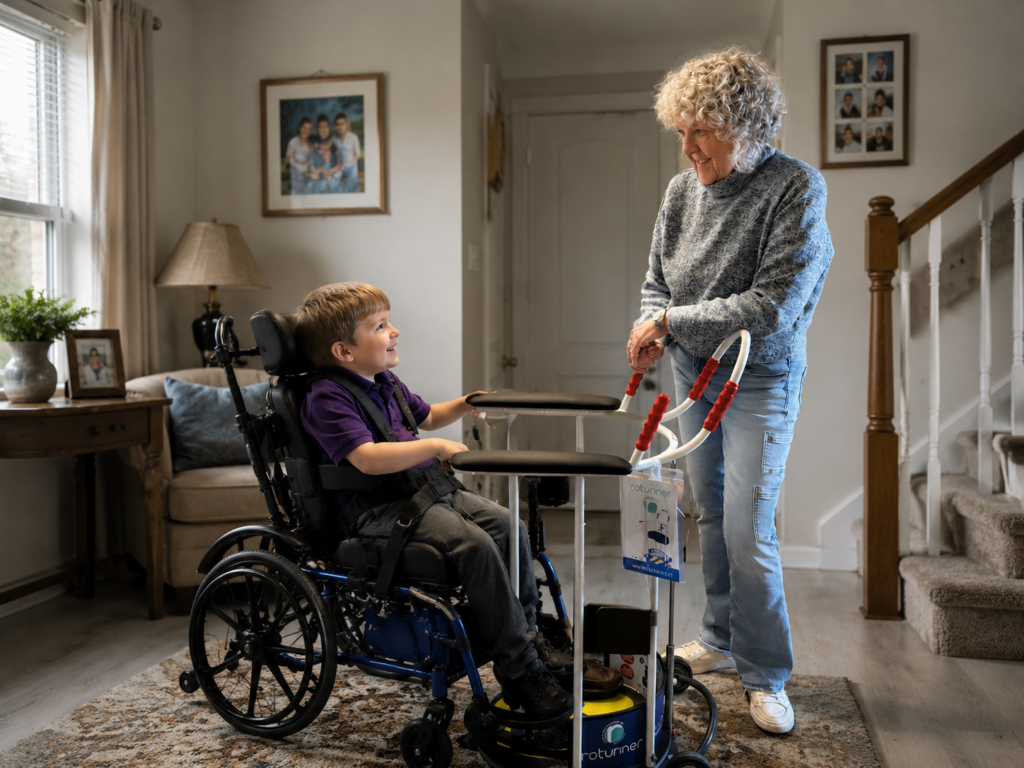
Manual lifting is the default for many families caring for a child who cannot transfer independently. In the early years, it is manageable. But children grow, and a child who could be lifted safely at age five may be significantly heavier and taller by age ten. By that point, the physical toll on parents and caregivers is significant, and the risk of injury to both the caregiver and the child increases with every transfer.
Standard transfer equipment also presents a cost problem. Many devices are sized for a specific developmental stage. Families invest in one device, the child grows out of it, and the cycle of assessment, funding applications, and purchasing starts again. For families already navigating complex care needs, this is an added burden they should not have to face.
There is also a deeper issue that often goes unaddressed: when a child is simply picked up and moved from seat to seat, they are a passive participant in their own care. They contribute nothing physically, have no agency in the process, and miss an opportunity to build the strength, body awareness, and confidence that support greater independence over time.
The Roturner’s wrap-around open frame provides a stable, structured support for the child to hold during a sit-to-stand transfer. Rather than being lifted by a caregiver, the child grips the frame, bears weight through their legs or upper body where possible, and actively participates in moving from one surface to another. The caregiver guides, they do not lift.
For younger or smaller children who cannot yet reach the handles comfortably, a stool placed inside the Roturner raises their standing height so they can grip the handles securely and complete the transfer safely. As the child grows taller, the stool is simply removed and the Roturner is used as standard. No new device is required. No new funding application. No interruption to the child’s established routine.
See the transfer sequence: How It Works – Roturner
Families caring for a child with a long-term physical disability face significant equipment costs over time. The Roturner removes the replace-as-they-grow cycle. The stool-to-no-stool transition is a simple, practical solution, the frame itself remains the same. This represents a meaningful saving in both cost and disruption, and it means the child always uses a device they are already familiar and comfortable with.
Why Active Participation Matters
Occupational therapists and physiotherapists consistently emphasise the clinical value of weight-bearing activity for children with conditions affecting mobility. Standing and partial weight-bearing transfers support bone density, muscle tone, and the neurological pathways involved in movement, benefits that passive lifting does not provide. A transfer device that keeps the child actively participating in their own care contributes to these therapeutic goals during every daily transfer, not just during scheduled therapy sessions.
When a child uses the Roturner, they grip the handles, bear weight, and initiate movement, even if only partially. Over time, this active role supports:
These outcomes matter not just clinically but personally. A child who participates in their own transfer is a child who is an active part of their own life, not just being moved through it.
Parents who regularly lift and transfer children with physical disabilities are at high risk of musculoskeletal injury, particularly to the lower back, shoulders, and knees. The risk grows as the child does. The Roturner’s single-caregiver design eliminates the need to lift. The device bears the structural load of the transfer while the caregiver guides. This protects the caregiver across years of daily transfers, not just today, but when the child is a teenager and a young adult.
The Roturner is appropriate for children who:
Conditions commonly supported by the Roturner in pediatric settings include:
An occupational therapist is best placed to assess whether the Roturner is appropriate for a specific child and to advise on correct use, including stool height, positioning, and the appropriate level of caregiver involvement.
One of the practical advantages of the Roturner in pediatric care is its portability. At approximately 25 lbs, it is light enough to be moved between rooms, brought to school, or repositioned throughout the day. It fits through standard residential doorways, making it as practical in a home bathroom as in a school support room or therapy space.
For school boards and educational settings supporting students with physical disabilities, the Roturner also addresses a real staffing challenge: transfers that previously required two adults can be managed by a single educational assistant or support worker, reducing logistical pressure on support teams and enabling more independent participation in the school day.
Many families have received funding to help cover the cost of the Roturner for their child. The following programs are worth exploring:
Funding eligibility varies by program, province, and individual circumstances. We recommend contacting the relevant organisation directly to confirm whether the Roturner qualifies under your child’s specific situation. You can also reach out to the Jaide Products team, we are happy to help guide you through the process.
There is no fixed minimum age, suitability depends on the child’s size, strength, and ability to respond to transfer cues, not their age. An occupational therapist can assess readiness and advise on appropriate use and stool height for a specific child.
For children with cerebral palsy who have some weight-bearing ability, a sit-to-stand transfer aid such as the Roturner offers a safer alternative to manual lifting. The child holds the frame for support, bears weight through their legs or upper body, and the caregiver guides the pivot rather than lifting. An occupational therapist can assess the child’s specific profile and recommend appropriate equipment and technique.
A stool is placed inside the Roturner’s open frame, raising the child’s standing height so they can comfortably reach and grip the handles. As the child grows taller, the stool is simply removed. The Roturner itself does not need to be replaced or modified, it adapts to the child’s height over time.
Yes. The Roturner is lightweight (~25 lbs), portable, and fits through standard doorways, making it suitable for classrooms, therapy rooms, and school washrooms. It can be operated by a single educational assistant or support worker.
The Roturner can support children who have limited leg function but sufficient upper body strength to hold the frame and support themselves through their arms during the transfer. An occupational therapist should assess the child’s specific abilities before use.
Several organisations offer equipment funding for children with physical disabilities in Canada, including Muscular Dystrophy Canada, March of Dimes Canada, and various provincial programs. The Heart & Stroke Assistive Devices directory is a useful starting point. Contact the Jaide Products team and we can help guide you through your options.
The Roturner is a single-size device that adapts for smaller users through the use of a stool placed inside the frame. Contact the Jaide Products team to discuss whether the standard device is appropriate for your child’s current size and care needs.
The right transfer device does not just make transfers safer, it changes how a child experiences their own mobility. With the Roturner, children move with support rather than being moved. They build strength, develop confidence, and grow into greater independence, and the device grows with them every step of the way.
→ Shop the Roturner — Standard & Bariatric Models